MCP server
SecondShift serves an MCP server at /mcp for coding agents and other
integrations. An agent can read jobs, runs and reports, start approved jobs,
and check a .secondshift.yaml before it is committed. An agent can never
grant access. Approvals, connections and secrets stay in the dashboard.
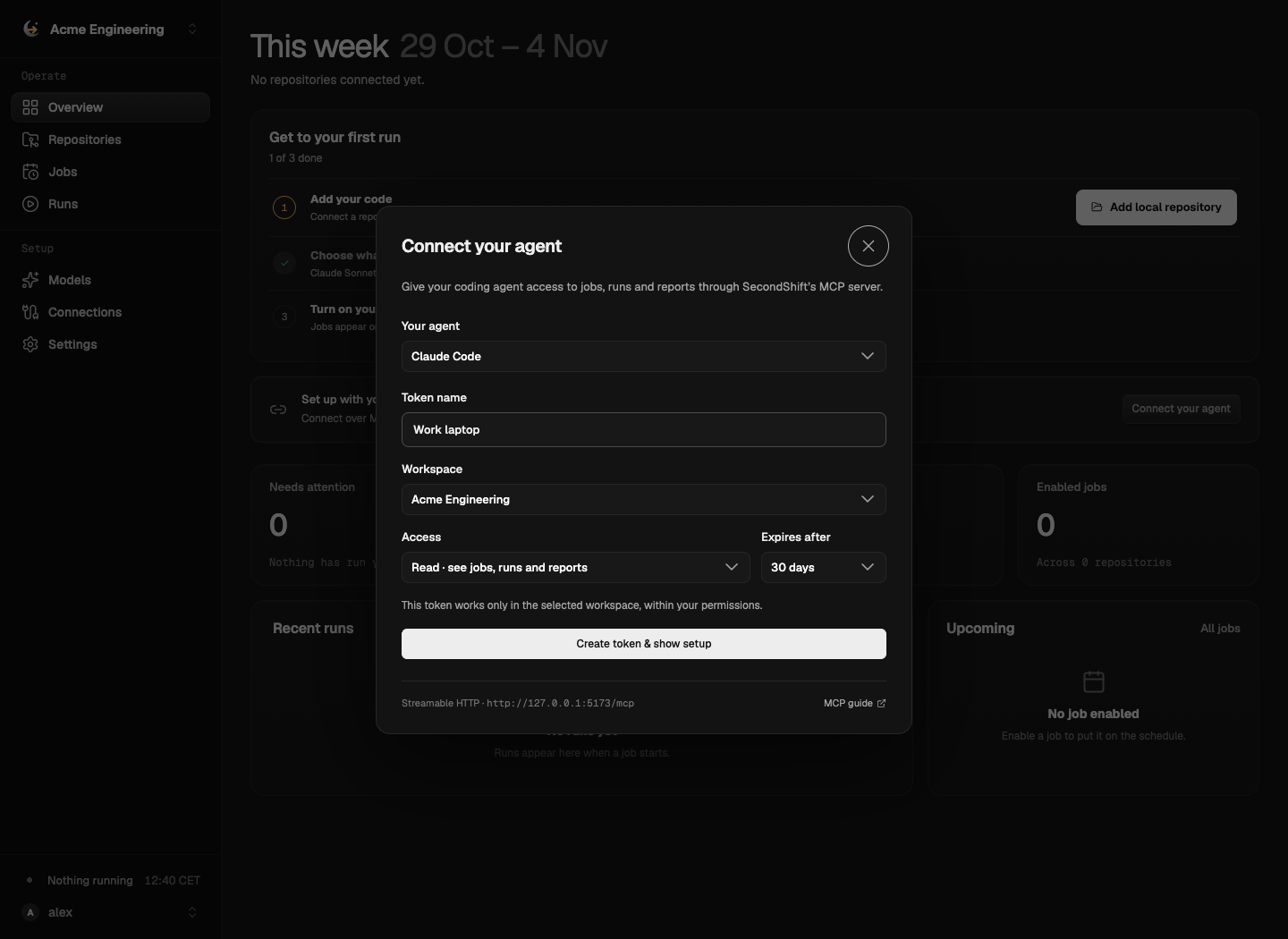
Connect a client
Section titled “Connect a client”- Open the account menu and choose Connect your agent. You can also connect from the empty overview or the API tokens account page.
- Choose Claude Code, Codex, Cursor or Other client. Name the token and pick the workspace it works in, its access and when it expires.
- Choose Create token & show setup and copy the command, configuration or connection settings. Follow the client instructions in the dialog. The token is shown once; copy the setup before closing.
Manage and revoke existing tokens from Account menu → API tokens.
Claude Code:
claude mcp add --transport http secondshift-acme https://secondshift.example.com/mcp \ --header "Authorization: Bearer ss_..."The server name ends with the workspace’s slug. Someone in several workspaces adds one server per workspace, and the names do not clash.
Other clients use the same URL and header. The server speaks Streamable HTTP. A client that reads a JSON config takes the same values:
{ "mcpServers": { "secondshift-acme": { "type": "http", "url": "https://secondshift.example.com/mcp", "headers": { "Authorization": "Bearer ss_..." } } }}In local mode the server is at http://127.0.0.1:8000/mcp while
secondshift up runs. Create the token from the account page there too. There
is no stdio transport. Every client uses a token, so the same access rules and
expiry apply everywhere.
API tokens
Section titled “API tokens”A token belongs to one person and works in one workspace. People manage their own tokens from their account page, across every workspace they belong to. A token has one of two kinds of access.
| Access | Allows | Creator needs at least |
|---|---|---|
read |
Every read and manifest tool | Member |
run |
Everything in read, plus starting runs and syncing repositories |
Admin |
A run token can start runs. Runs spend model budget. A run may change data
in connected services through tools an owner approved for its job. The form
says so when run is picked. It offers run only for workspaces where the
person is an admin or owner. With one workspace, the form has no workspace
picker.
A token covers one workspace so that content from one workspace cannot steer an agent into another. A prompt injection in one workspace’s report cannot reach a second workspace’s reports or jobs. A leaked token exposes one workspace.
Rules:
- Access is the token’s kind limited by the creator’s current role. It is
checked on every request. A demoted creator’s
runtoken can only read. A creator who leaves the workspace loses every token for it. - Owner actions are never available to a token. These include grants, approvals, connections, secrets, model providers, limits and members.
- Only a hash of the token is stored. Tokens start with
ss_so secret scanners can find leaked ones. - Every token expires. The creator picks 7, 30 or 90 days. The default is 30.
The server’s
SECONDSHIFT_API_TOKEN_MAX_DAYS(90 by default) caps the choice and is always offered. No token lasts forever. - Lowering the maximum affects only new tokens. Existing tokens keep their expiry.
- A person can revoke their own tokens. An owner limits other people’s
tokens through membership. Removing someone stops their tokens at once.
Demoting them to member makes their
runtokens read only. - The token list shows each token’s name, access, expiry and last use. It shows the workspace when the person belongs to several.
All tools act on the token’s workspace. IDs are the same as in the dashboard. An ID from another workspace is reported as not found.
Jobs and runs
Section titled “Jobs and runs”| Tool | Access | Arguments | Returns |
|---|---|---|---|
list_jobs |
read |
repository_id?, enabled? |
Each job’s ID, key, name, repository, schedule, whether it is enabled, and whether it is ready to run. A job that is not ready lists what blocks it. |
get_job |
read |
job_id |
The job’s details, limits and recent runs, and whether it is ready to run. |
list_runs |
read |
job_id?, repository_id?, status?, period?, page?, page_size? |
A page of runs, newest first, with status, times and token usage. Page size is at most 50. |
get_run |
read |
run_id |
Status, events, model usage and the start of the output. |
get_run_report |
read |
run_id |
The run’s Markdown report. A report over 200 KB is cut and marked as cut. |
submit_task |
run |
repository_id, definition, idempotency_key, revision?, input?, not_before?, pull_request? |
The assignment ID, run details and whether a new run was accepted. |
cancel_task |
run |
run_id |
Cancel an ad hoc task that has not started. |
run_job |
run |
job_id |
The new run’s ID and status. Poll get_run to follow it. |
sync_repository |
run |
repository_id |
The synced commit, whether the manifest is valid, and the repository’s jobs. |
run_job follows the same rules as Run now in the dashboard. It fails
with a plain message when the repository is disabled, no default model is
connected, or a required capability is not approved.
run_job also refuses while the job already has a queued or running run. It
returns that run’s ID instead, so the agent can follow it with get_run. An
agent stuck in a loop cannot queue runs faster than they finish. Run now
follows the same rule.
Standalone tasks
Section titled “Standalone tasks”For a dashboard walkthrough, queue behavior, and copyable agent examples, see Run one-off tasks.
Use New task on a repository page, or call submit_task from an agent.
Choose Write a task to provide instructions directly, or Use a skill to
select a committed SKILL.md and optionally add context. Neither needs a job in
.secondshift.yaml. Both run against a pinned repository commit with the same
workspace limits, tool permissions and report history.
For a written task, omit definition.skill and supply nonblank input:
{ "repository_id": 12, "definition": {"name": "Review setup instructions"}, "input": "Check the installation experience for a new contributor. Return a report with concrete fixes.", "idempotency_key": "written-setup-review-2026-11-03"}To reuse a repository skill, include its committed path:
{ "repository_id": 12, "definition": { "name": "Review setup instructions", "skill": ".agents/skills/docs-drift/SKILL.md" }, "input": "Focus on the installation and first-run experience.", "idempotency_key": "setup-review-2026-11-03"}Request only tools listed by list_bindings. definition uses the same shape
as a manifest job, with an optional skill. A task without a skill requires
nonblank input; its original instructions are frozen and included in the agent
prompt and stored input artifact. It never tries to read or generate a skill file.
A standalone task cannot specify a schedule, triggers or job history. Requires and notify are optional. Omit revision to use the
repository’s followed branch; an explicit branch or full commit SHA also works.
The accepted task pins the exact commit, definition, input and submitting user.
Changes to the branch after acceptance do not alter it.
Reuse the same key with identical arguments when retrying after a lost response.
The result returns the original run with started: false; changed arguments or
a different submitter using that key are refused. Keys are scoped to a repository
and retained for the task’s retention window. started: true means a new run was
accepted; execution can still be queued. Multiple tasks can wait for a repository,
up to SECONDSHIFT_TASK_QUEUE_LIMIT (100 unfinished tasks by default). Only one
ad hoc run per repository is dispatched at a time. Saved jobs retain their
existing overlap rules.
Set not_before to a timezone-aware ISO timestamp, for example
"2026-11-04T01:00:00+01:00", to defer execution. Omit it to run when capacity is
available; past times are immediately eligible. The commit is pinned at
submission, even for a delayed task. Eligible tasks run in requested-start order,
then acceptance order; a future task does not block an immediate one. The worker
checks waiting tasks every 15 seconds by default and recovers submissions after
a restart or execution-queue outage. This is an earliest start, not a guaranteed
execution time. Repository state and the submitter’s role are checked again
before execution. Use cancel_task or Cancel task on the run page before it
starts. Cancellation is idempotent; running tasks cannot be canceled this way.
HTTP clients use POST /api/tasks with the same submission fields and
POST /api/runs/{run_id}/cancel to cancel a queued ad hoc task. Both require
workspace run permission. Queue saturation is a 409 refusal; a retry with the
original key still returns the accepted run.
Standalone tasks can use only connections that do not require approval, within their permitted tools and repository scope. An existing job’s grant cannot authorize a standalone task. Workspace execution selection and run limits apply. Changing connection consent or disconnecting it stops subsequent tool calls and report deliveries. No endpoint can set credentials, provider scopes or sandbox options.
Follow result.run.id with get_run and get_run_report, or find the task in
Runs on the dashboard. Standalone runs have job_id: null; job carries their
display name. Existing job-run fields keep their values. get_run also exposes
submission_input, so the original request remains reviewable if execution fails
before input capture. The session-authenticated HTTP equivalent is POST /api/tasks with the same body.
Writing manifests
Section titled “Writing manifests”| Tool | Access | Arguments | Returns |
|---|---|---|---|
list_bindings |
read |
none | Each binding in the workspace with its kind, whether it is connected, and the tools a job may request. Each tool has a name, description, input schema and a flag for tools that may change data. Built-in GitHub and Sentry tools are listed even when they are not connected. |
check_manifest |
read |
yaml, repository_id? |
Whether the manifest is valid, with the same error a sync shows. For a valid manifest, each job’s bindings with their status in this workspace: ready, missing, needs_approval or unavailable. |
list_capability_needs |
read |
none | What every job in the workspace has requested and what is still missing. |
list_bindings shows only tools an owner allowed on the connection. It
reports how many other tools exist without naming them. A job that requests a
tool the owner has not allowed cannot run, so listing it would only create
approval requests.
check_manifest does not read the repository. It checks that skill paths
are well formed but cannot check that the files exist. A sync reads them from
the committed revision. Pass repository_id to count approvals that the
repository’s synced jobs already have.
Rate limit
Section titled “Rate limit”Each person can make SECONDSHIFT_MCP_RATE_LIMIT requests to /mcp per
minute (300 by default). All of their tokens share the limit, so a new token
does not reset it. The dashboard is not limited by it. A request over the
limit fails with “Too many requests.” and a Retry-After header with the
seconds to wait.
Runs are already bounded by their own limits, the worker queue and the workspace token budget. The rate limit only stops runaway clients.
What is not exposed
Section titled “What is not exposed”| Left out | Why |
|---|---|
| Grants and approvals | An agent driven by repository content must not approve its own access. |
| Enabling a job’s schedule | Letting a job run unattended is a human decision. |
| Connections, secrets and model providers | Owner only. Credentials never leave the server. |
| Endpoints, server URLs, auth types and OAuth details | A manifest may not contain them. An agent that never sees them cannot copy them into one. |
| Limits, members and invites | Owner or admin settings with no use in an agent loop. |
| Local repository paths | They describe the host’s file system. |
Untrusted content
Section titled “Untrusted content”Reports, run events and tool descriptions are untrusted. Reports are model output built from repository content. Tool names, descriptions and schemas of custom MCP servers and HTTP APIs come from third parties. Any of them can contain instructions aimed at the agent that reads them.
Results that carry this content include a note saying so. Tool descriptions are cut at 500 characters. A client should treat a report as data to act on, not as instructions.
Each tool call is recorded with the tool name, the token, its creator and
whether it succeeded. Arguments and results are not recorded. Requests
refused by the rate limit are not recorded. Records are deleted after
SECONDSHIFT_RUN_RETENTION_DAYS, like run history.